For commercial, utility-scale, and industrial solar projects, the quality of the PV module is a critical factor that directly affects system performance and long-term energy production. Solar panels are expected to operate reliably for decades while being exposed to sunlight, temperature fluctuations, humidity, wind, and other environmental conditions. Choosing modules based only on their initial price can therefore create significant risks for long-term project performance.
International standards, manufacturer qualifications, and durability testing provide important references when evaluating solar modules. Standards such as IEC 61215 and IEC 61730 establish requirements for module design, performance, and safety. Meanwhile, manufacturer classifications such as BloombergNEF’s Tier-1 designation are often considered when assessing supplier bankability. Understanding these benchmarks can help project developers make more informed decisions when selecting PV modules.
Key IEC Standards for PV Modules
International Electrotechnical Commission (IEC) standards provide widely recognized benchmarks for evaluating photovoltaic module performance and safety. Two important standards in the solar industry are IEC 61215 and IEC 61730.
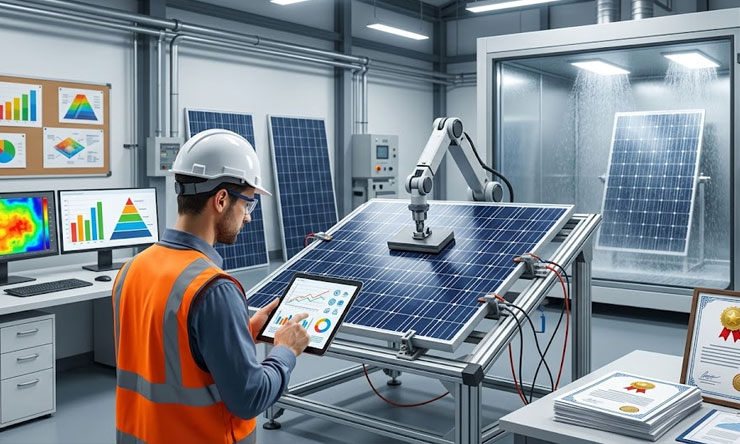
IEC 61215 focuses on design qualification and type approval for terrestrial photovoltaic modules. Testing under this standard evaluates whether a module can withstand various environmental and operating stresses. These include temperature cycling, humidity exposure, mechanical loading, and other conditions that can affect module performance over time.
Meanwhile, IEC 61730 addresses photovoltaic module safety. It covers electrical and mechanical safety requirements designed to reduce risks associated with electrical insulation, fire, and physical construction.
Compliance with these standards does not mean that every module will perform identically for 25 or 30 years. Instead, they provide standardized testing frameworks that help demonstrate whether a module design meets defined requirements for quality, reliability, and safety.
Understanding BloombergNEF Tier-1 Classification
The BloombergNEF Tier-1 classification is another term frequently encountered when evaluating PV module manufacturers. Unlike an IEC certification, Tier-1 is not a technical product certification. It is primarily associated with the bankability of manufacturers.
A Tier-1 manufacturer generally has a track record of supplying modules for large-scale solar projects that have received financing from recognized financial institutions. This can provide an indication that the manufacturer has established market acceptance and sufficient financial credibility to participate in major projects.
However, Tier-1 status should not be interpreted as a guarantee that every individual module will have superior technical performance. Project developers should still examine the specific module’s datasheet, certifications, warranty conditions, degradation rates, and independent test results.
Combining manufacturer bankability with technical evaluation provides a more complete approach to procurement decisions. Financial stability can be relevant to long-term warranty support, while technical specifications help determine whether a particular module is appropriate for the project’s operating environment.
Important Durability Tests for PV Modules
Solar modules can be installed in very different environments, from coastal areas with high salt exposure to agricultural regions where ammonia may be present. Additional durability tests can therefore be important depending on the project’s location.
| Standard / Test | Purpose | Critical For |
|---|---|---|
| PID Resistance | Evaluates resistance to Potential Induced Degradation | High-humidity and high-voltage environments |
| Salt Mist Corrosion | Tests resistance to salt spray and corrosion | Coastal installations |
| Ammonia Resistance | Evaluates resistance to ammonia exposure | Agricultural and livestock facilities |
| Snow & Wind Load | Assesses mechanical resistance under structural loads | Storm- or snow-prone regions |
| Humidity Testing | Evaluates performance under prolonged moisture exposure | Hot and humid environments |
Potential Induced Degradation (PID) can reduce module performance under certain combinations of voltage, humidity, temperature, and system configuration. Selecting modules with appropriate PID resistance can therefore be particularly important for projects operating in demanding climates.
Salt mist testing is especially relevant for solar installations near coastlines. Salt particles and moisture can accelerate corrosion of susceptible materials and electrical components. Similarly, ammonia resistance can become an important consideration for installations near livestock farms or agricultural operations.
Mechanical load testing is also essential because modules must withstand wind and, in some regions, snow loads throughout their operating life. The mounting structure and installation method must be designed consistently with the module’s mechanical specifications.
LID and LeTID Performance
Long-term module reliability also involves understanding degradation mechanisms that can reduce energy output. Two commonly discussed phenomena are Light-Induced Degradation (LID) and Light and elevated Temperature-Induced Degradation (LeTID).
LID can occur after a module is exposed to sunlight, potentially resulting in an initial reduction in power output. LeTID is associated with certain cell technologies and can become more significant under elevated operating temperatures.
Advances in solar cell technology have helped manufacturers reduce these degradation effects. N-type cell technologies and other advanced designs are increasingly used to achieve lower degradation and more stable long-term performance.
Gallium-doped silicon is another approach used in some module technologies to reduce certain forms of degradation associated with traditional silicon materials. However, performance depends on the specific cell architecture, manufacturing process, and module design.
For this reason, project developers should examine the manufacturer’s published degradation warranty rather than relying solely on broad claims about cell technology.
Why Module Quality Matters for Long-Term Projects
PV modules represent one of the most important long-term assets in a solar power project. Their performance affects energy yield, revenue, return on investment, and the overall financial model of the installation.
A module with a slightly lower initial purchase price may not necessarily provide the lowest total cost over its operating life. Degradation rate, warranty terms, environmental resistance, temperature coefficient, mechanical strength, and expected energy yield should all be considered during procurement.
Project developers can also examine independent testing results, product certifications, manufacturer track records, and warranty conditions. These factors help reduce the risk of selecting modules that may not perform as expected under actual operating conditions.
Conclusion
Understanding PV module standards and durability testing is essential when developing reliable commercial and industrial solar projects. IEC 61215 and IEC 61730 provide important benchmarks for module qualification and safety, while additional tests for PID, salt mist, ammonia, humidity, and mechanical loads can help determine whether a product is suitable for a particular environment.
BloombergNEF Tier-1 classification can provide useful information about manufacturer bankability, but it should be considered alongside technical specifications and product-level evidence. By evaluating cell technology, degradation performance, environmental resistance, warranties, and independent testing, project developers can make better-informed module selections and improve the prospects of achieving stable energy production over the long term.
Topics #PV module #solar panel standards #solar technology